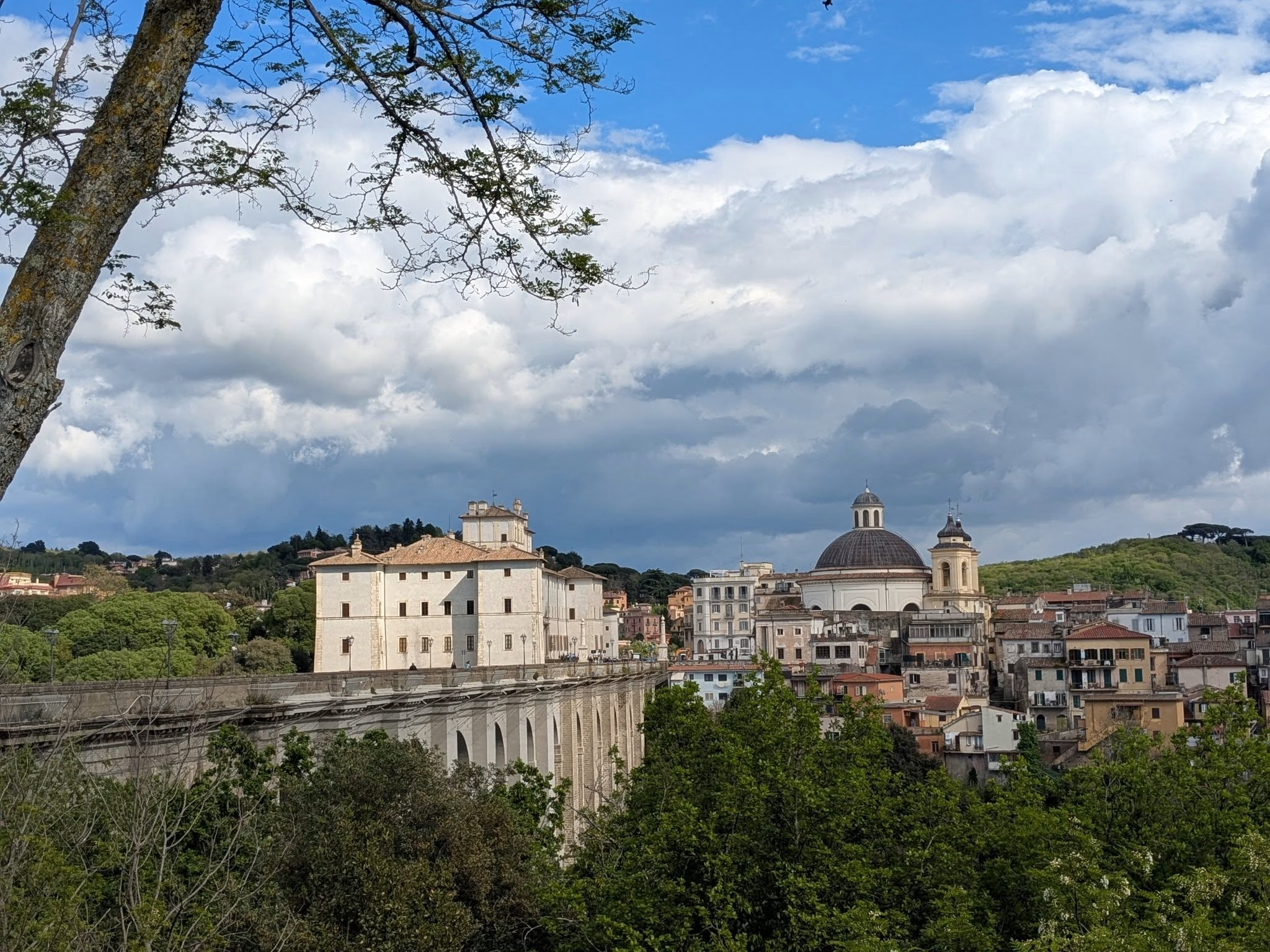
Ariccia, in an area known as the Castelli Albani (Alban Hills) in the province of Roma, near the Italian capital, is one of the favorite destinations for Romans themselves, not least because of its famed porchetta, pork that has been slowly roasted with finocchiella (a kind of wild fennel), rosemary, salt and pepper.
Ariccia travel guide and tourist information
How to get to Ariccia by public transport
There are two ways to get to Ariccia from Rome. There is a direct bus (Co.Tra.L) from the Anagnina metro station, at the end of line A. The city does not have a railway station, but the neighboring town, Albano Laziale, does. The walk from the station of Albano to the center of Ariccia is no more than about 20 minutes. This way has two advantages. Firstly, Albano itself is also quite beautiful, and secondly, you have to cross the famous bridge between the two cities, from which you have a gorgeous view of the most important points of interest in Ariccia itself.
What to see in Ariccia

The bridge leading to Ariccia was originally constructed by Pope Pius IX in 1854, destroyed by retreating German troops and rebuilt in 1947. It crumbled 20 years later and was again rebuilt.
In 1661 the Chigi family acquired the city and in 1740 had the Palazzo Savelli Chigi constructed, the background location for several tv shows and movies, the most famous one of which being Visconti’s Il Gattopardo. Nowadays the Palazzo often hosts exhibitions and concerts. The adjacent Parco Chigi is the city’s most interesting park.
Pope Alexander XII was a member of the Chigi family and lived in Ariccia for a while. The Collegiata di Santa Maria Assunta (see picture) was commissioned by him and constructed by Gian Lorenzo Bernini. The interior is graced by a famous Borgognone fresco.
Ariccia’s main square was also designed by Bernini. It is called Piazza di Corte and is lined by several interesting buildings. The main street is the Corso Garibaldi, which leads from the Piazza di Corte to the Piazzale Mazzini and the Belvedere.
Fountain of the Three Spouts does not sound nearly as poetic as the Fontana delle Tre Cannelle.
The Porta Romana was also constructed by Bernini, while the Porta Napoletana was the work of Carlo Fontana.
Sanctuary of the Madonna del Galloro, with a facade by Bernini, 2 km out of the city. Each year, on December 8, a young lady heads a procession leading up to the Sanctuary. The procession is therefore called Procession of the Lady.
Ruins of the Villa of (the Roman Emperor) Vitellius, also out of town, as well as numerous other excavated ruins.
Top 10 tourist attractions Ariccia
Curiosities
On the SS218 between Ariccia and Rocca di Papa, around km. 11,600 there is a stretch of road the locals call salita in discesa (going uphill while going downhill). If you stop your car at this point, and keep the hand brakes turned off, your vehicle will roll uphill. Or at least, seem to roll uphill, since in reality this is an optical illusion.
Suburbs
The municipality of Ariccia includes the so-called frazioni of Vallericcia and Fontana di Papa.
A brief history of Ariccia
Ariccia is one of the oldest towns in the area and during the early days of the Roman Republic, being the leading city of the Latin League, it even contended with Rome for a short while. In pre-Roman days its was even more important because of its association with the Goddess Diana. The city thanks its name to Aricia, the wife of the Roman forest God Hippolytus.
Thanks to its nearness to Rome, its position as the first bigger city along the Via Appia on the way to southern Italy, its cool climate and the quality of its food and wine many important and wealthy Romans had villas built in Ariccia and the city became rather wealthy, a wealth that after the fall of the Roman Empire made it a frequent target of sackings by Goths, Vandals and Saracens.

The area where Ariccia was founded was already inhabited in the Iron Age.
After, together with the other Latin tribes, opposing Rome‘s expansion for long periods, it finally became a municipality. When Lucio Cornelio Silla fought Caio Mario, the city took the former’s side and was burned and destroyed by the latter (87 BC). Later, in Imperial times, the city flourished and became, because of its climate, a popular holiday destination.
After the Barbarians demolished Ariccia, the city was reconstructed. In order to better be able to defend it, this happened on top of the hill, where the acropolis used to be.
In the 17th century, Bernini and Carlo Fontana gave the historical center of Ariccia its present view.
It was a feud of the Tuscolo, the Malabranca, the Savelli and the Chigi, before being annexed by Napoleon.
On February 1st, 1944, Ariccia was hit by Anglo-American allied bombings. Both the Monumental Bridge, and (part of) the Palazzo Chigi collapsed.
Leave a Reply