
The Lateran Baptistry (Battistero Lateranense) is an ancient buidling next to the Basilica of St. John in Lateran in Rome. Emperor Constantine himself is said to have been baptized here. The actual name of the chapel is San Giovanni in Fonte. It is the prototype of almost all baptisteries since.
A brief history of the Battistero Lateranense in Rome
The Battistero Lateranense was built in 440 AD, by Pope Sixtus III. Since it is rumored that Emperor Constantine was baptized here in the 4th century, it may have been built on top of an already existing building. Going even further back in time, there used to be a 1st century AD villa and a 2nd century thermal bath in this site.
The Lateran Baptistery required frequent restorations in the course the centuries. The last time this occurred was in 1637.
The building connecting the Baptistery to the Loggia delle Benedizioni was added in 1884, by Virginio and Francesco Vespignani.
What to see in the Lateran Baptistery
The main space of the baptistery is octagonal. This hall gives access to several chapels.
Exterior
The portal dates back to 1575. The exterior frieze is decorated with the coats of arms of the Chigi family and was made by Francesco Borromini in 1657.
Baptistery
The interior of the Baptistry is octagonal. The central part is lower than the rest, with an eight column ring supporting an (also octagonal) architrave. This ring is topped by a second row of eight thinner white marble columns supporting the octagonal lantern. There is a rail between the columns, protecting the baptismal font itself.
The long inscription in Latin on the architrave was written by Pope Sixtus III. It says: “Be reborn from this divine seed. Dip, O sinner, in this sacred river. Emerge purified, whether thou sinned or thine fathers did. Those not reborn here will noy enjoy the afterlife of the blessed”.
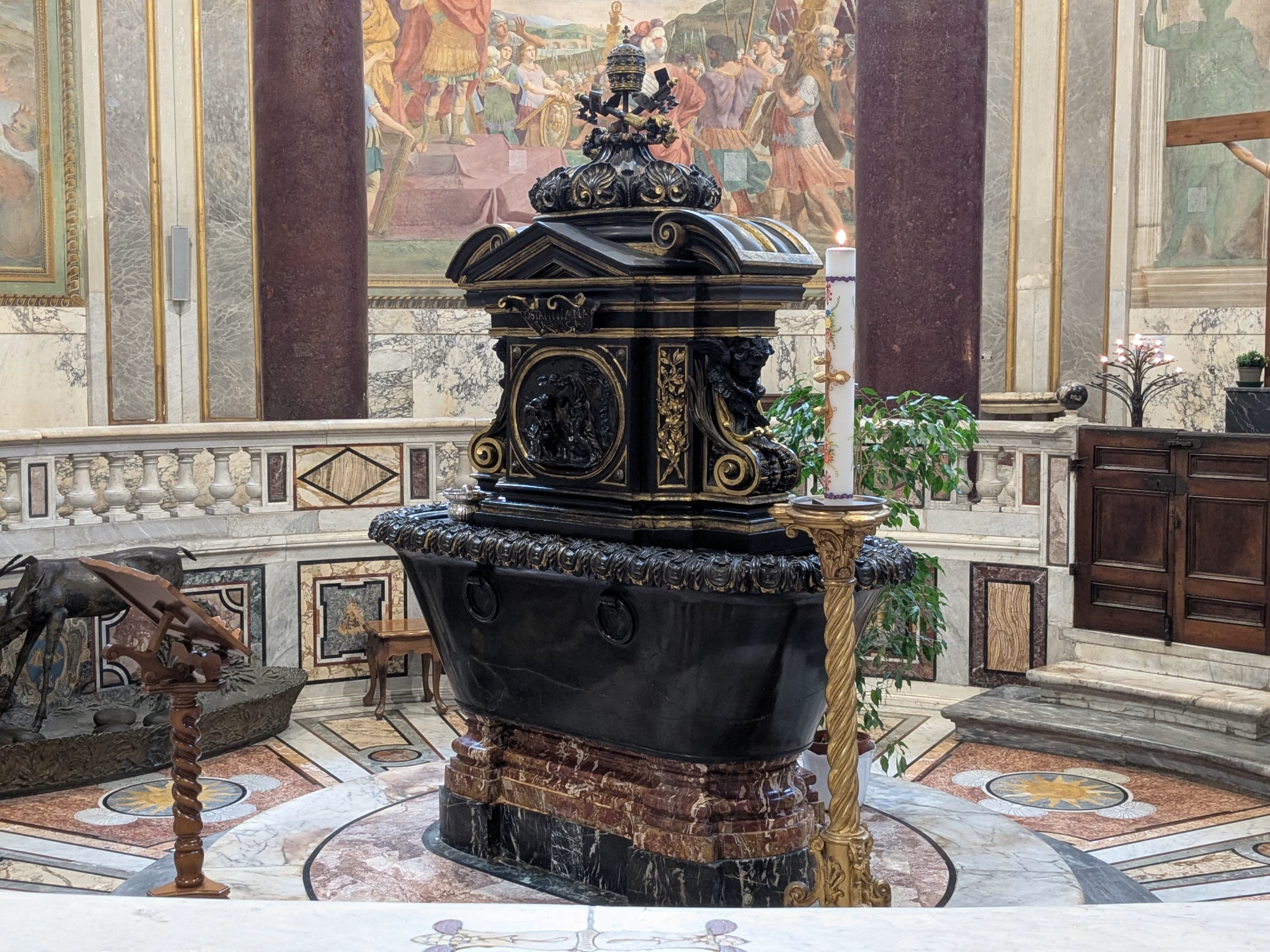
The baptismal font consists of a green basalt urn with a 17th century bronze lid. In the 8th century, this was used for baptism by immersion. The lid was made by Ciro Ferri.
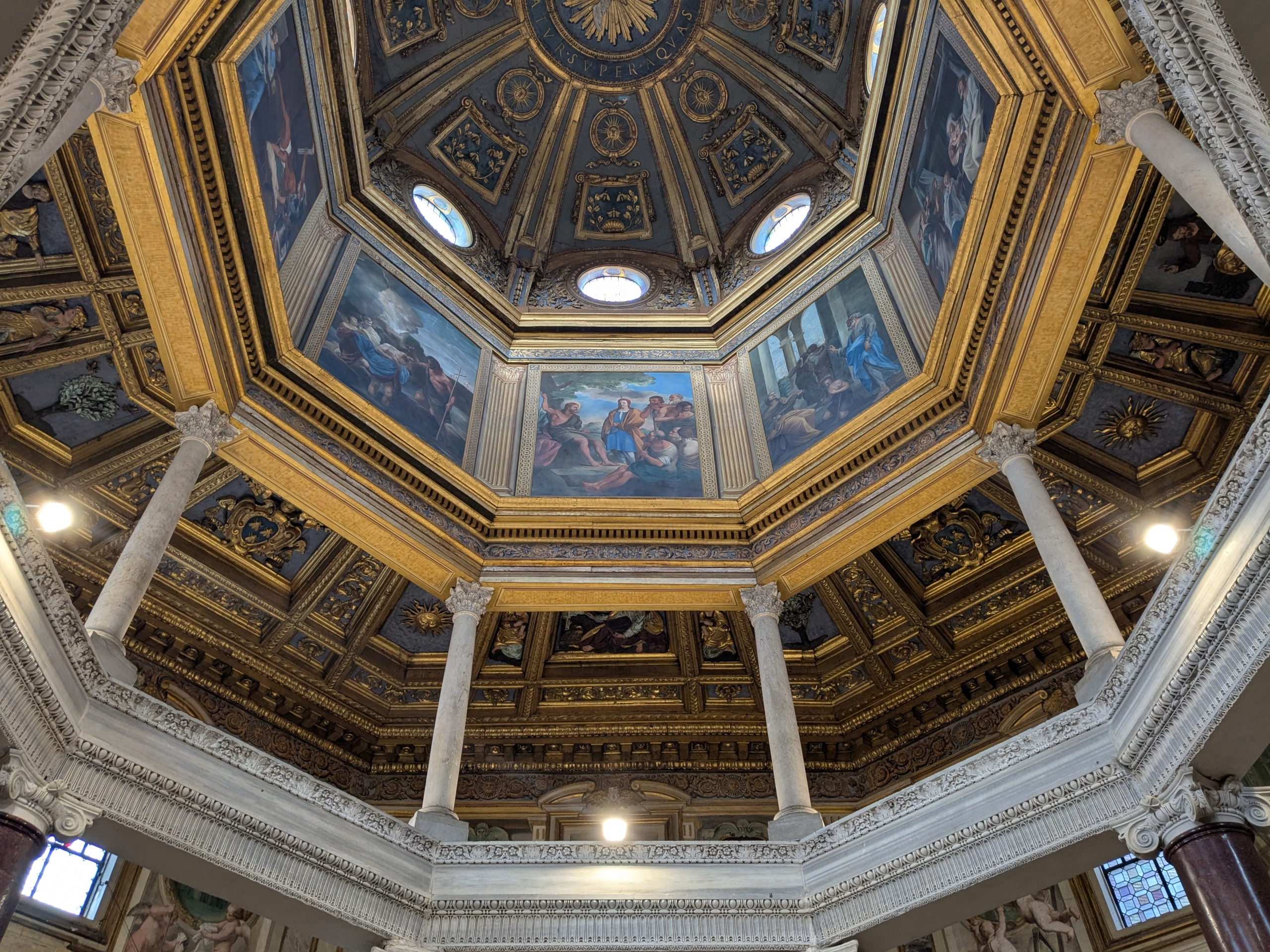
The lantern is decorated with eight paintings by Andrea Sacchi (1599-1661). The paintings depict events in the life of St. John the Baptist. In chronological order, “Apparition of the Angel to Zechariah”, “Mary’s Visit to St. Elizabeth”, “Birth of the Baptist”, “Circumcision of the Child”, “the “Baptist in the Desert”, “the “Preaching of the Baptist”, “Baptism of Jesus” and “Beheading of St. John the Baptist”. The original paintings, now in the Palazzo Lateranense, have been replaced by copies.
In 1967, Pope Paul VI placed the two bronze deer next to the baptismal font. This used to be graced by seven silver fountains in the shape of deer, which were later stolen by barbarians.
The large frescoes decorating the walls depict events from the life of Emperor Constantine and were created by Andrea Camassei, Giacinto Gimignani, Carlo Maratta (“Destruction of the Idols”), and Carlo Mannoni.
Chapel of San Giovanni Battista and chapel of San Giovanni Evangelista
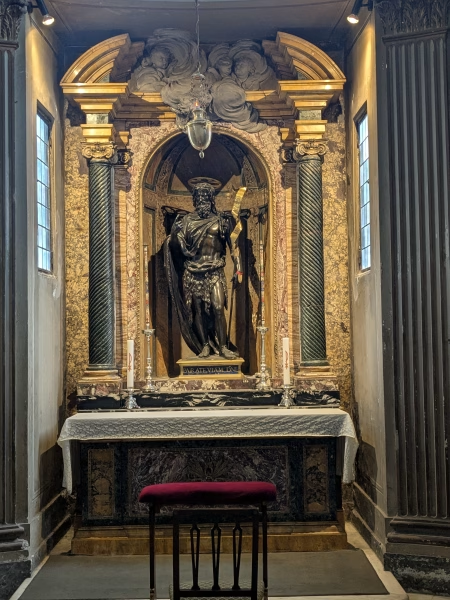
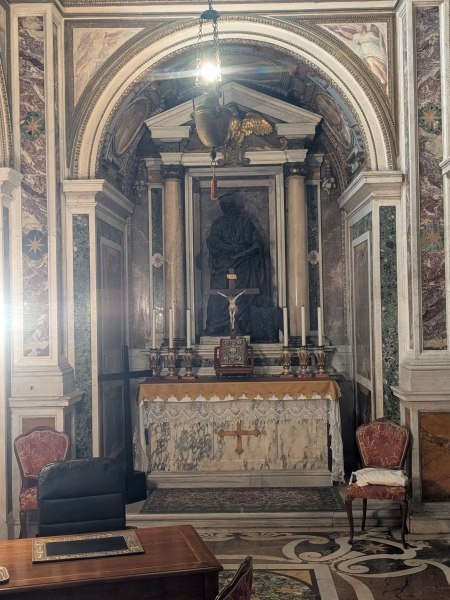
The statue of “St. John the Baptist” in the chapel dedicated to the saint was the work of Luigi Valadier. The chapel itself was renovated in 1780, by Giovanni Battista Ceccarelli. The doors to the chapel date back to the 5th century. Taken from the Terme di Caracalla,
The Chapel of St. John the Evangelist has bronze doors that were made in 1196 by Uberto and Pietro of Piacenza. The statue of the saint was also sculpted by Luigi Valadier.
Chapel of Santa Rufina e Seconda and chapel of the Santi Cipriano e Giustina
In 1154, under Anastasius IV, the original narthex of the baptistery was transformed into a space with two chapels.
The chapel of the saints Rufina and Seconda is named for two martyrs during the persecutions by Emperoro Valeriano in the 3rd century. The chapel contains a wooden Pietà. The altarpiece depicts Christ crowning the two martyrs. In 1757, the Lercario family restored the chapel. The tombs of Nicolao Lercario and Nicolao Maria Lercario have found a space here.
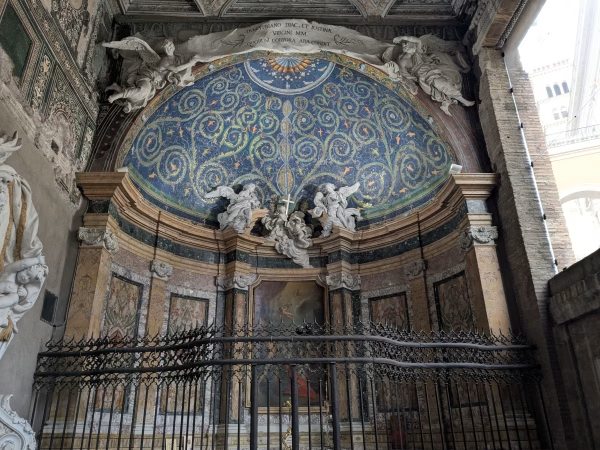
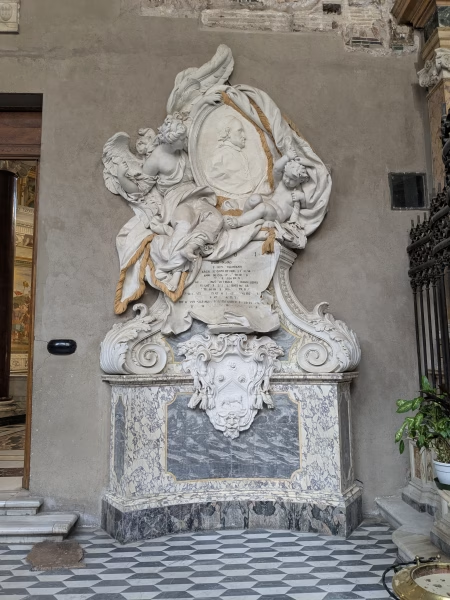
The chapel of the saints Cipriano and Giustina is graced by a 5th century mosaic and an altarpiece depicting the Martyrdom of St Justina. In 1767, the Borgia family of Velletri restored the apse. The funerary monument for Alessandro Borgia was the work of Tommaso Righi.
Chapel of San Venanzio
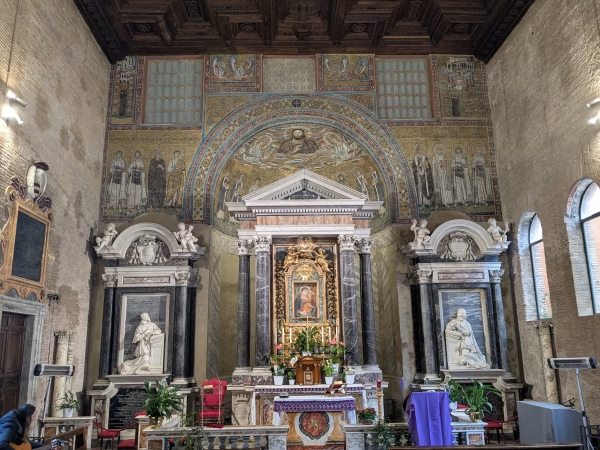
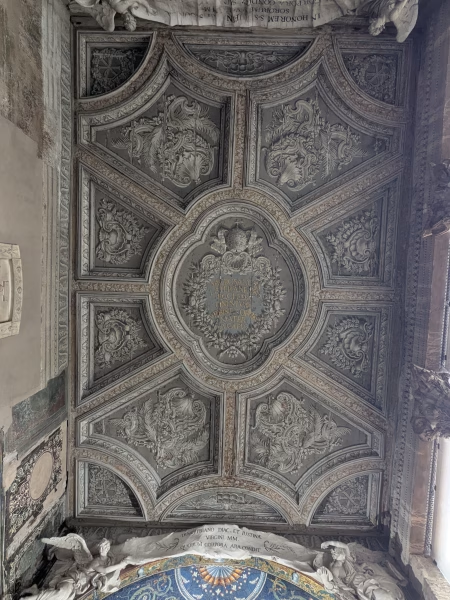
The Chapel of San Venanzio was commissioned in the mid-7th century to house the relics of the Dalmatian martyrs Venantius and Domnius. Highlights are the beautiful 16th century wooden ceiling, with an effigy of the Madonna in heaven in the centre, and the mosaics adorning the apse.
The apse mosaic depicts Christ blessing saints and bishops, including the pope offering a model of the church. Unfortunately a big part of it is hidden behind the altar.
Carlo Rainaldi was resonsible for the tympanum and the tombs of the cardinals. Jacopo Antonio Fancelli made the sculptures, and Paolo Naldini the portrait and the cherubs.
Useful information
The address of the Battistero Lateranense is Piazza di San Giovanni in Laterano, 4 – 00184 Rome (tel. +39 0669886452 ). Metro: San Giovanni. Bus: 16, 51, 85, 87, 186. Opening hours: 9.00-12.30 / 16.00-18.30. Entrance fee: Free.
Piazza San Giovanni in Laterano, 4 – Rome
Sources
- Touring Club Italiano – Roma.
- The Rome Guide – Step by step through history’s greatest city (Mauro Lucentini).