
The Mamertine Prison in Rome is the building where the saints Peter and Paul are supposed to have been imprisoned before they managed to escape after having converted their guards to Christianity. The prison is located underneath the Church of San Giuseppe dei Falegnami.
A brief history of the Mamertine Prison in Rome

The Mamertine Prison was built in the 7th century BC and is thus the oldest prison in Rome. Construction was ordered by the 4th king of Rome, Ancus Martius. Until the Middle Ages this ancient state prison was called Tullianum.
Initially, its function was probably that of a cistern for water that came from a small well in the floor.
Generally prisoners were not held here for very long periods. Either they were executed or simply starved to death.
According to legend, Saint Peter stumbled on his way down into the prison, thereby supposedly leaving an imprint of his head in the wall.
The two saints, who were locked up in the dark, managed to conjure up some water. The guards Processo and Martiniano were so impressed that they converted immediately to Christianity and let them escape. The Latin word for “source of water” is tullus, which is one reason why the prison may be called Tullianum. There are also historians who claim that the prison owes its name to either the 3rd (Tullus Hostilius) or 6th (Servius Tullius) king of Rome
Other VIPs that spent time in the Mamertine Prison were the King of Numidia and the Gallic leader Vercingetourix, who had tried to lead his people into a revolt against Caesar (52 BC).
In the 15th century the prison came to be considered a holy building. It is dedicated to San Pietro in Carcere (“Saint Peter in Prison”).
Description
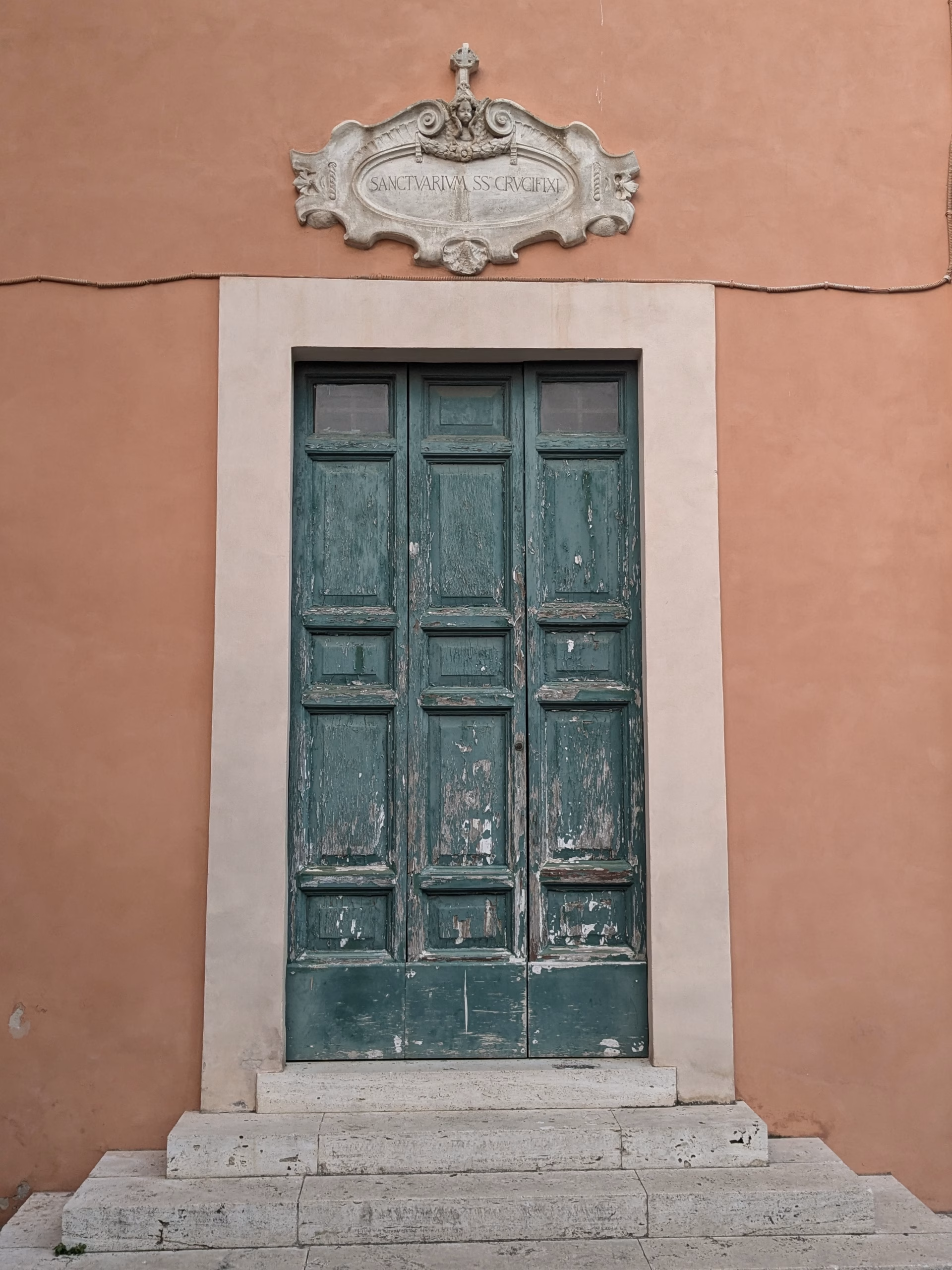
The present marble façade dates back to the year 40 BC and covers the original tuff stone one, which was made two centuries earlier. An inscription shows the names of two consuls, C. Vibius Rufinus and M. Cocceius Nerva. The actual entrance is around the left corner.
The entrance opens up into a trapezoid space, which is called the carcer. Underneath this space is a round room, which is the actual Tullianum. Until fairly recently, this space could only be entered through a hole in the floor, but nowadays there are steps leading down. The hole itself has been with an iron gate.
There might have been a smaller entrance in the right wall. This was located above the present street level and is now bricked up. There were also other rooms called Lautumiae, which had been dug out in the tuff stone.
There are two plaques on this wall, of which the first one lists its most famous prisoners and how they died. The other one names the imprisoned martyrs and saints and who their persecutors were.
An iron door at the back of the Tullianum probably led to the sewer system, which was called Cloaca Maxima. It is possible that this was used to get rid of the dead bodies, which then floated through the sewers to end up in the river Tiber.
An altar with the busts of Saints Peter and Paul is placed against the back wall.
Opening hours and admission
Rione: Campitelli. Metro: Colosseo. The Mamertine Prison is opened from 09.00 until 19.00 hours (in winter only till 17.00 hours). Admission is 10 Euros. Children below the age of 10 do not pay. The OMNIA Vatican & Rome Card is valid.
What to know before you go
Although there is a large sign saying Carcere Mamertino on the front of the church, the actual entrance is around the corner. The nearest bus stop is Fori Imperiali/Campidoglio (line 87). The nearest metro stop is Colosseo (line B). To walk to the Carcere from the Via dei Fori Imperiali, you take the Via di San Pietro in Carcere. Despite its name, this street runs behind the prison, so you take the cobblestoned Clivo Argentario on the left and follow this till you come to the Via del Tullanio.
Clivo Argentario/Via del Tulliano, 00186 Rome
Bibliography
Lucentini, Mauro, The Rome Guide, Step by Step through History’s Greatest City.
Leave a Reply