
The Palazzo Bracaccio in Rome, which used to house the National Museum of Oriental Art, used to be owned by the New York socialite Mary Elizabeth Bradhurst Field, whose daughter was married to Prince Salvatore Brancaccio.
A brief history of the Palazzo Brancaccio in Rome
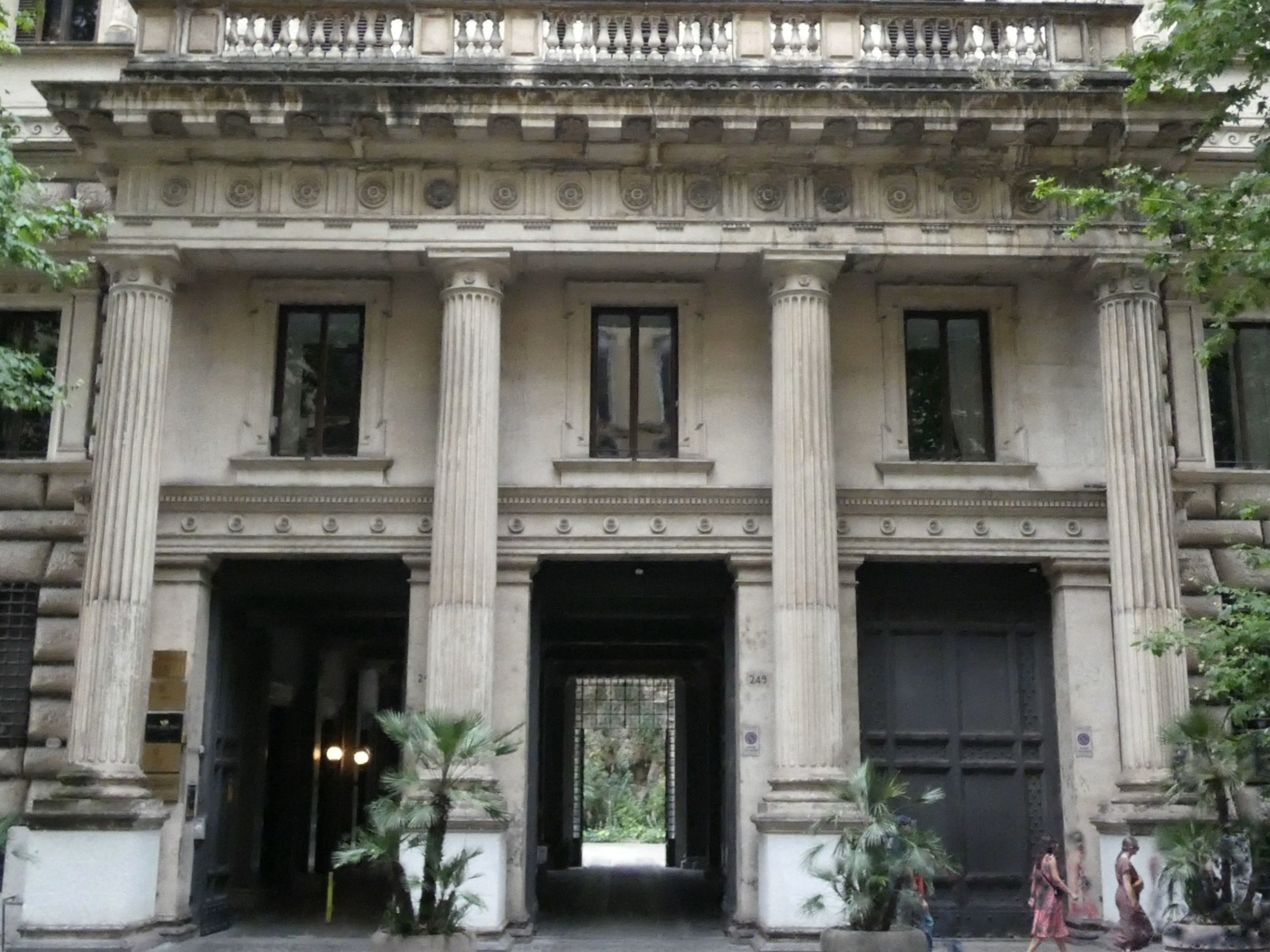
The Palazzo Brancaccio started it existence as a church with an attached convent belonging to the Clarisse Franciscan Sisterhood of Santa Maria della Purificazione ai Monti. However, after the Unification of Italy religious congregations were abolished and the building became public property. Bradhurst Field bought it from the city in 1879 and hired the architect Gaetano Koch for a reconstruction.
When urbanization led to the construction of the Via dello Statuto, she was forced to destroy the convent and to turn the rest of the building into a residential palazzo. When the building became too small for the Brancaccio‘s and the Fields, the palazzo was enlarged along the Via Merulana. The architect of this enlargement was Luca Carimini.
The paintings and other decorations in the building are by Francesco Gai, a Roman artist who was the Brancaccio’s house painter.
Later, the Palazzo Brancaccio was restructured in order to accommodate the collection of the Museo Nazionale d’Arte Orientale. In order to return the palazzo to its original state, some fake walls and ceilings needed to be removed.
Palazzo Brancaccio today
Part of the complex, including the park, a “Coffee House” decorated by the local painter Francesco Gai, the foyer and various rooms, is being used as a venue for weddings and other social events.
The mezzanine, formerly the Giuseppe Tucci National Museum of Oriental Art, now houses Spazio Field, a new exhibition centre under the artistic direction of the Saloni di Palazzo Brancaccio, featuring frescoes, ornate rooms and the royal family’s alcove.
The Teatro Brancaccio, on the corner with the Via Mecenate, also used to be part of the Palazzo Brancaccio.
Address, opening hours and admission
Address: Viale del Monte Oppio, 7 – Rome. (This is a side entrance to the main building. The much more impressive Via Merulana facade used to be the entrance to the museum, which was closed in December 2017 and moved to a new location in the EUR district.)
Leave a Reply