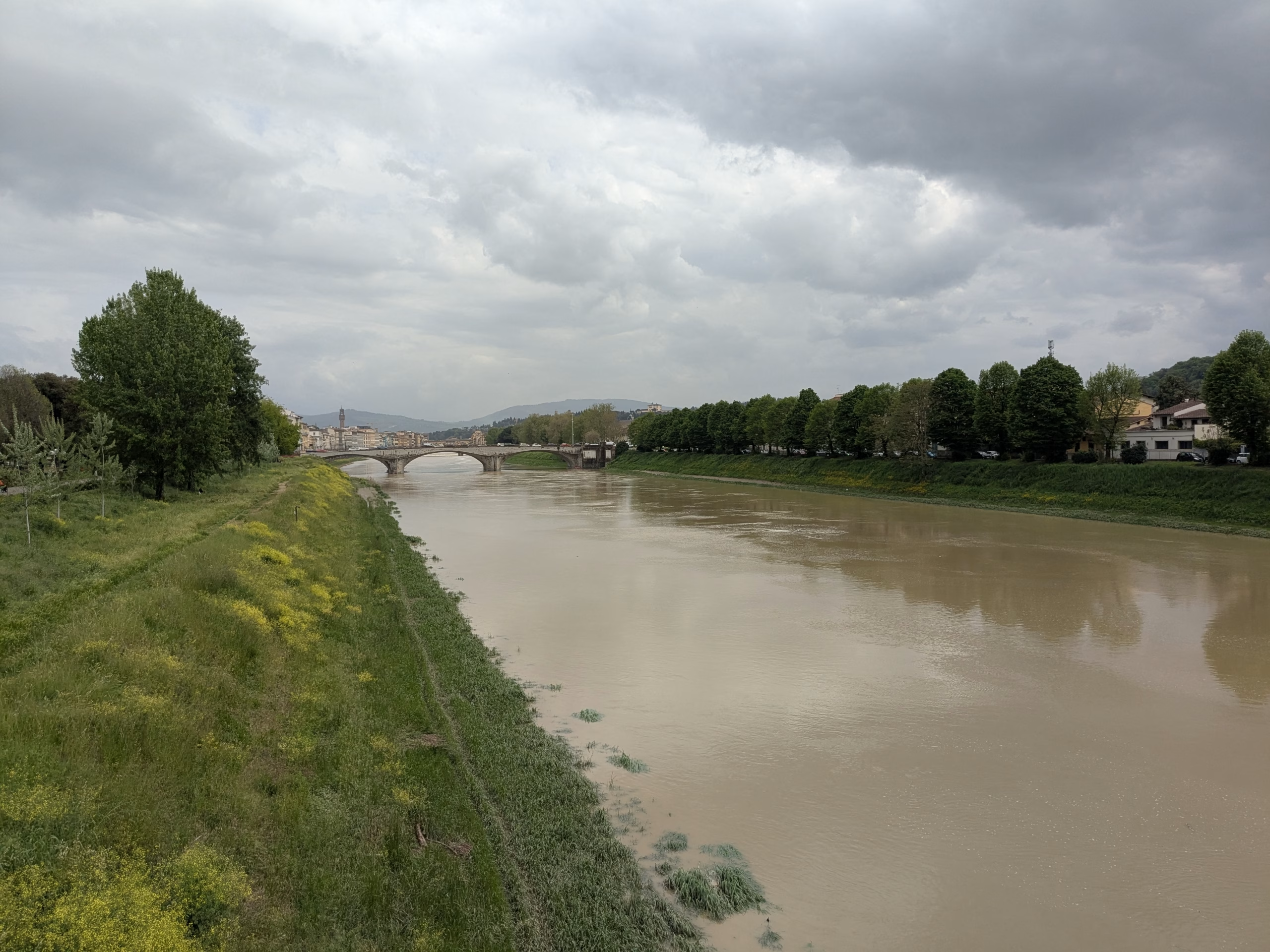
The Ponte alla Vittoria is a bridge over the river Arno in Florence. The bridge connects the south-western part of the city (Quartiere 4, also known as Isolotto-Legnaia) with several streets leading to the city center. In its present form, the bridge was inaugurated in 1946. The structure itself is not that interesting, but the views from it are quite nice in both directions.
A brief history of the Ponte alla Vittoria in Florence
The Ponte alla Vittoria was constructed in 1835, by two French brothers, Marc and Jules Seguin. At the time, the bridge was known as the Ponte San Leopoldo, after Grand Duke Leopold II, who had ordered its construction.
Originally, the Ponte alla Vittoria was a suspension bridge. It was made of iron, and had four pillars, topped by marble lions. Two of the lions were later moved to the vicinity of the Porta Romana, while the other two were place at the entrance to the Parco delle Cascine, near the bridge.
Until 1914, a toll had to paid to the French company that had built the bridge. From then on, the locals were exempt, though they still had to pay for their animals and automoniles.
In the early 20th century, the city decided to build a new bridge, right next to the old one. The plan was not to destroy the old bridge before the new one had been completed. World War I interfered, however. Work was only restarted after the Battle of Vittorio Veneto (1918), when the Italians defeated the Austro-Hungarian Empire. The new bridge, in honor of this battle, was called Ponte alla Vittoria. Its inauguration took place in 1932.
In 1944, the bridge was destroyed by the retreating Germans, in an attempt to halt the allied troops.
Almost immediately, its reconstruction started. The current structure of reinforced concrete has three arches and is characterized by bronze parapets.
The street continuing southward from the bridge is still called Via del Ponte Sospeso.