
The Porta Tiburtina in Rome is also known as the Porta San Lorenzo and is the entrance to the Tiburtino district. The gate consists of an ancient Roman and a medieval part.
A brief history of the Porta Tiburtina in Rome
The name Tiburtina comes from the Via Tiburtina, since that street left the city through this gate. The name Porta San Lorenzo came from the Church of Saint Lawrence Outside the Walls, since the Via Tiburtina led to this church. To confuse matters further, at one point the gate was also known under the name Porta Taurina, thanks to the bull’s head on the arch’s keystone.
Originally the gate was just a commemorative arch, in honor of the three aqueducts, the Acqua Marcia, the Acqua Tepula and the Acqua Giulia, and it was not until later that it became part of the Aurelian Walls.
It is probably Aurelian who was responsible for the two towers flanking the gate.
In the 5th century BC Augustus restored the gate. Later, as inscriptions indicate, Vespasian and Septimius Severus also had work done on the gate and/or aqueducts.
Another inscription, over the outer arch, mentions a restoration by Honorius, who also had the inner arch, later removed by Pope Pius IX, built.
Aechaeological finds
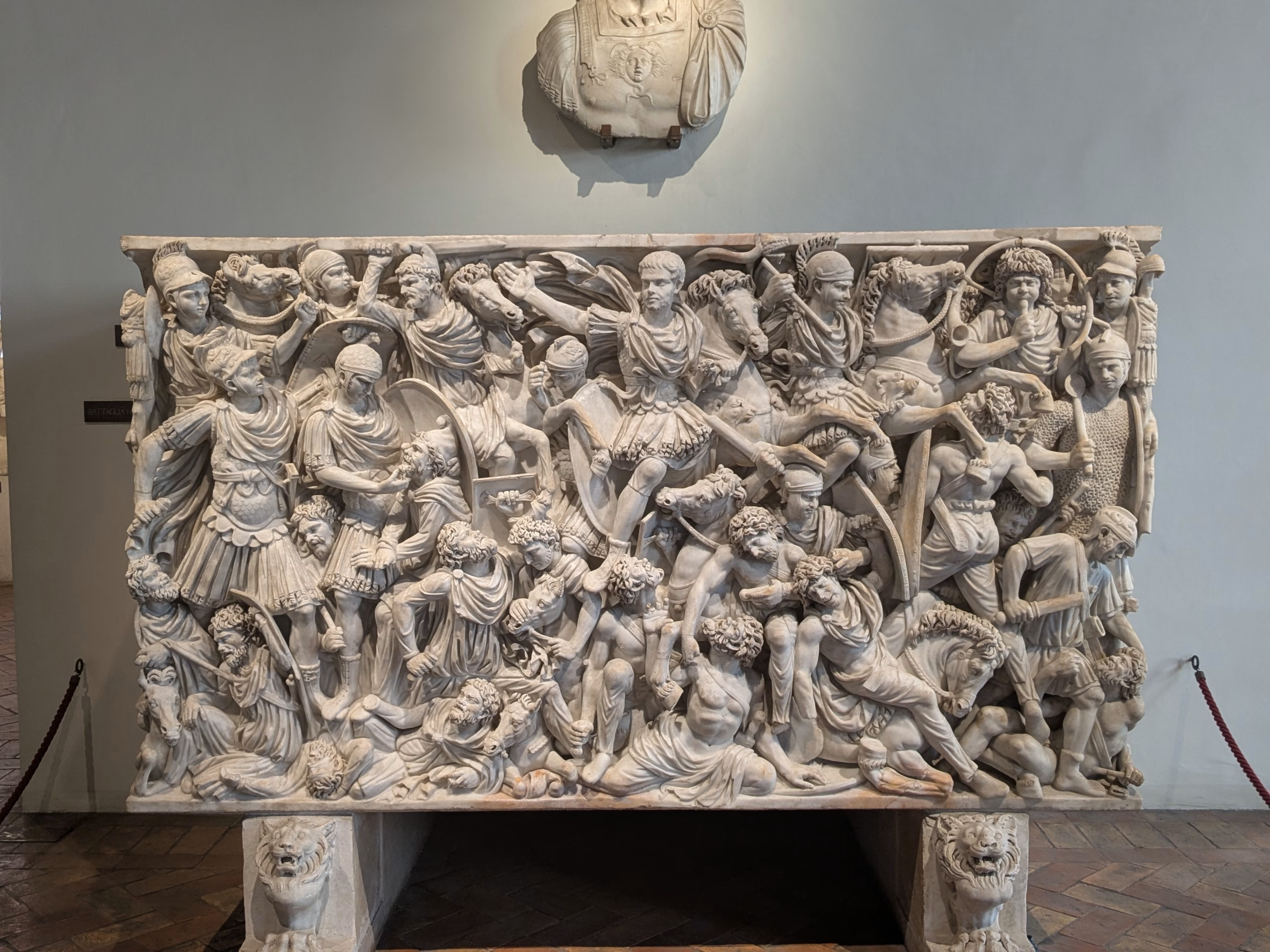
In 1621, the so-called Ludovisi Sarcophagus was found near the Porta Tibertina. It is named for Cardinal Ludovico Ludovisi. The cardinal’s collection of antiquities is now in the Palazzo Altemps. The sarcophagus itself dates back to around 250 AD. The high relief shows a battle between Romans and (presumably) Goths. The deceased, in the center of the relief, does not participate in the battle. He is thought to have been one of the sons of Emperor Decius.
Address
The Porta Tiburtina can be found along the Viale di Porta Tiburtina. District: Quartiere Tiburtino.
Viale di Porta Tiburtina – Rome
Bibliography
Lucentini, Mauro, The Rome Guide, Step by Step through History’s Greatest City.
Photos
© Renato Prosciutto (unless otherwise indicated).
Leave a Reply