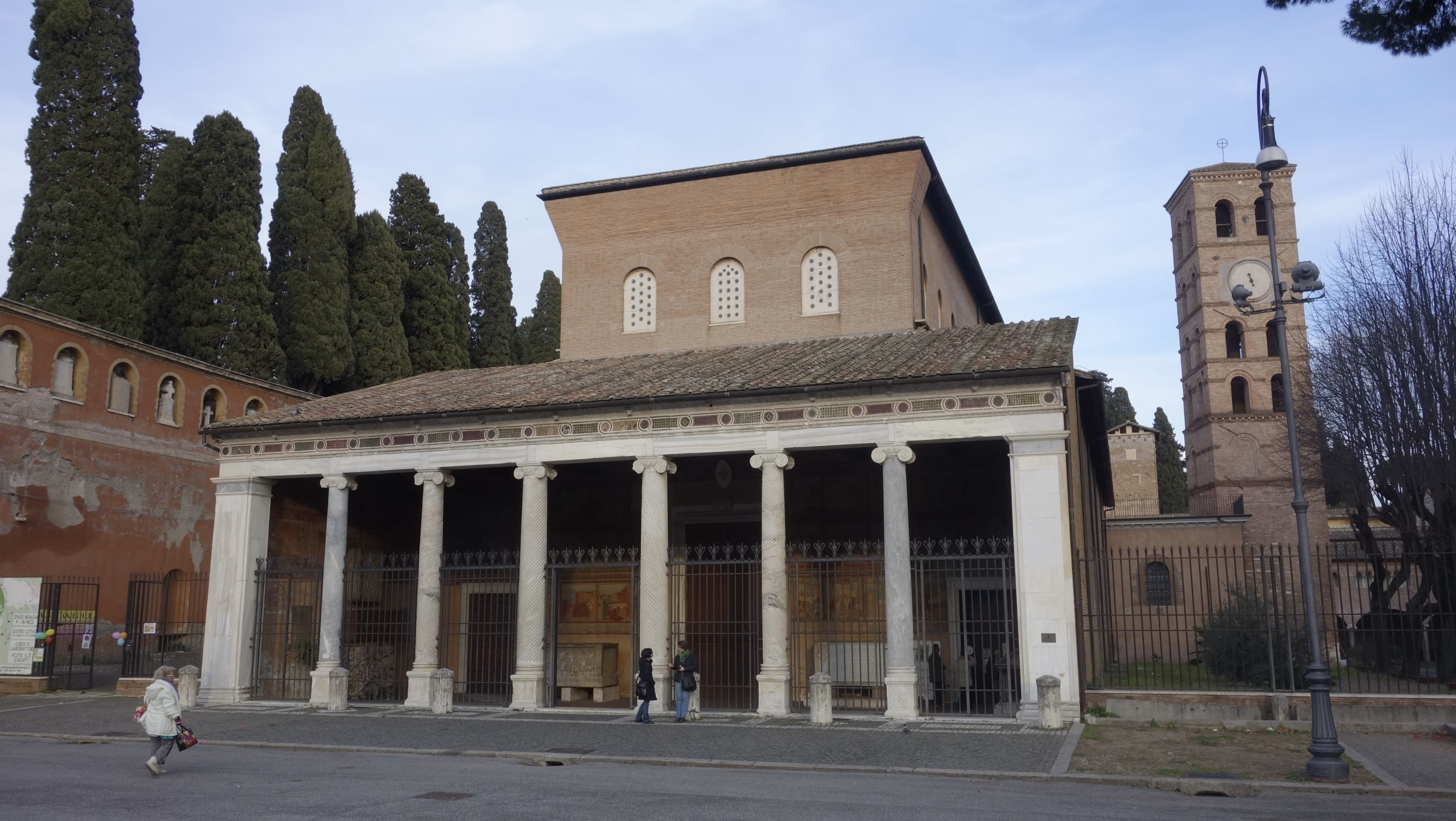
The Papal Basilica of Saint Lawrence outside the Walls (Basilica Papale di San Lorenzo Fuori Le Mura) is one of the seven so-called Pilgrim Churches of Rome. It is the only one of the five Papal basilicas without a Holy Door. The church is located just north of the city’s student district, unofficially known as San Lorenzo, to which it also gave its name.
A brief history of the basilica of Saint Lawrence outside the Walls in Rome
The Basilica of Saint Lawrence outside the Walls started its existence as a small oratorium. It was built in the 4th century by the emperor Constantine, in the spot where the saint was thought to have been martyred in the year 258.
Towards the end of the 6th century Pope Pelagius II had an actual church constructed at this site. In the 13th century it was Pope Honorius II who had a new one built, in front of the existing church. The two churches were later united into one structure.
Towards the end of the 11th century Pope Clement III had already had the cloister built. In those days there was also a fortified village called Laurentiopolis around the basilica.
The square bell tower, built at the end of the twelfth century, has eight floors. The top five are open with mullioned pillars. In the 18th century, some floors needed to be bricked up, in order to reinforce and stabilize the walls. The clock was added in the same period.
Saint Lawrence Outside the Walls (19th century).
Between 1855 and 1864 several elements of the church were modified by the architect Virgilio Vespignani.
In 1943 the area was bombed, causing irreparable damage to the mosaics in the portico and the frescoes on the facade. The restoration after the war undid most of Vespignani‘s changes. The basilica was mostly restored to its medieval architecture.
What to see
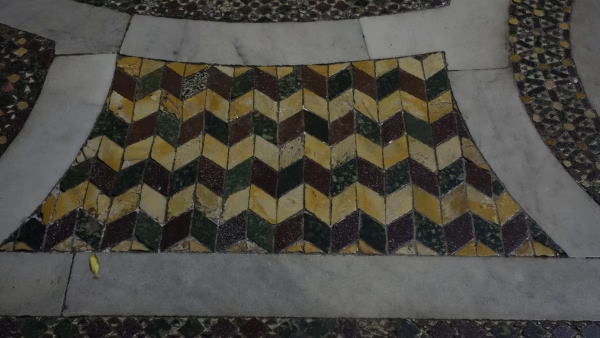
Cosmatesque decorations
The basilica retains its original Cosmatesque floor and ambones dating back to the same period. The ambo of the Gospel features the balconcino delle predicationes, adorned with an eagle clutching a lion in its talons.
The two lions beside the entrance were already present when the first version of the church was built.
The funerary monuments in the baroque Santa Ciriaca Chapel were the work of Pietro da Cortona.
Vespignani designed the San Tarcisio Chapel in the 19th century. Giovanni Serodine painted the “Beheading of John the Baptist” in this chapel in 1619.
The funerary chapel of Pope Pius IX dates back to the end of the 19th century. In order to do this the narthex of the 6th century basilica was used.
The ciborium dates from 1148.
The bishop’s seat is decorated with mosaics and colorful marble.
The mosaic on the triumphal arch depicts Christ between the saints Paul, Stephen, Hippolytus, Peter and Lawrence. Pope Pelagius is depicted handing Christ a scale model of the basilica.
The church is decorated with 13th century frescoes depicting events in the lives of Saint Lawrence and Saint Stephen.
Saint Lawrence is buried in the presbytery, between four black and white columns.
Saint Stephen, who is considered to be the first Christian martyr, is also buried in the church. It was Pope Pelagius II who had his mortal remains brought from Constantinople to Rome.
Other notable people buried inside the church or Pope Hilarius (461-468) and Alcide de Gasperi. De Gasperi was the founder of the Christian Democrat party and Italy’s first prime minister in 1945.
The cosmatesque decorations of the portico are the work of the Vassaletti family, who specialized in this art.
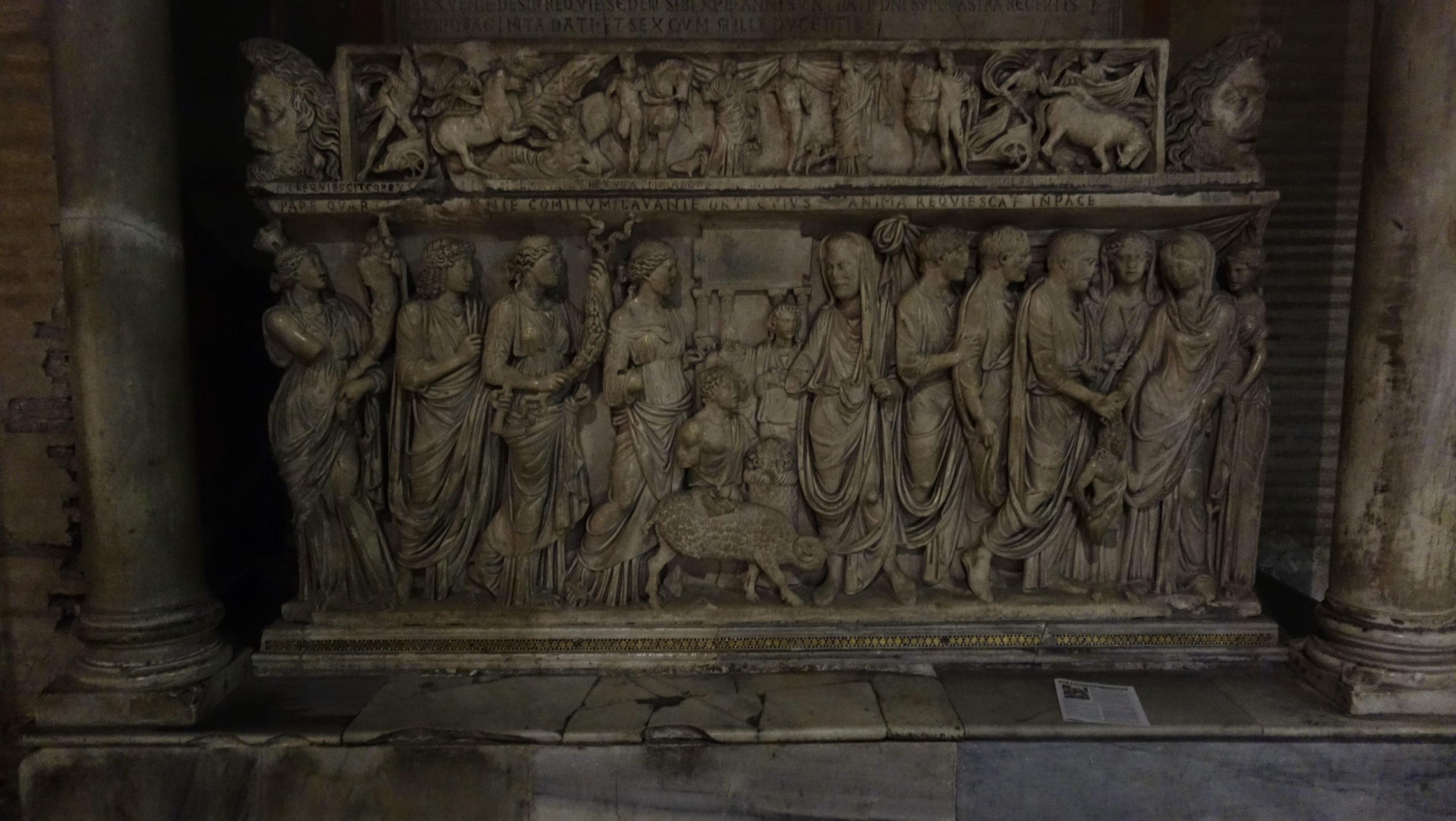
The portico contains two ancient sarcophagi. Both are decorated with events from both the Old and the New Testament. There are also some decorations depicting harvest scenes.
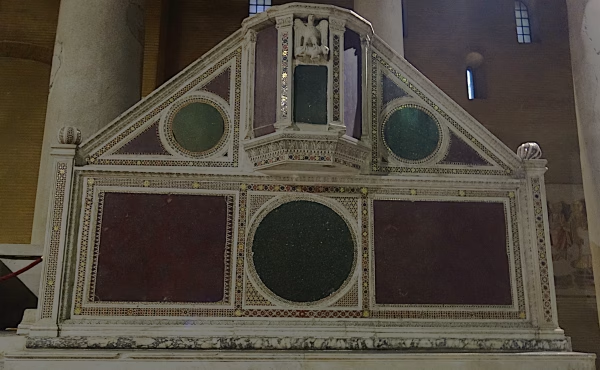
Tomb of Cardinal Fieschi
The 13th century tomb of Cardinal Guglielmo Fieschi is built against the interior facade. It originally consisted of a sarcophagus and a fresco below a tympanum. The fresco did not survive the world war II bombings, however. The tympanum is decorated with cosmatesque motifs. The sarcophagus dates back to the 3rd century and is decorated with an elaborate (pagan) wedding scene.
Piazzale del Verano
The column topped by a statue of Saint Lawrence on the square in front of the church dates back to 1865. Virginio Vespignano was responsible for the column, Stefano Galletti sculpted the statue.
Address, opening hours and admission
The address of the Basilica di San Lorenzo Fuori Le Mura is Piazzale del Verano, 3 – Rome (tel. +39 06491511.). Bus: 3, 19, 71, 88, 443, 542, 545, 11n. Opening hours (2021): From 07.00 till 12.00 and from 16.00 till 19.00. Admission: Free.
Saint Lawrence outside the Walls Basilica – Piazzale del Verano 3, Rome
To provide the best experiences, we use technologies like cookies to store and/or access device information. Consenting to these technologies will allow us to process data such as browsing behavior or unique IDs on this site. Not consenting or withdrawing consent, may adversely affect certain features and functions.
Functional
Always active
The technical storage or access is strictly necessary for the legitimate purpose of enabling the use of a specific service explicitly requested by the subscriber or user, or for the sole purpose of carrying out the transmission of a communication over an electronic communications network.
Preferences
The technical storage or access is necessary for the legitimate purpose of storing preferences that are not requested by the subscriber or user.
Statistics
The technical storage or access that is used exclusively for statistical purposes.The technical storage or access that is used exclusively for anonymous statistical purposes. Without a subpoena, voluntary compliance on the part of your Internet Service Provider, or additional records from a third party, information stored or retrieved for this purpose alone cannot usually be used to identify you.
Marketing
The technical storage or access is required to create user profiles to send advertising, or to track the user on a website or across several websites for similar marketing purposes.


Leave a Reply