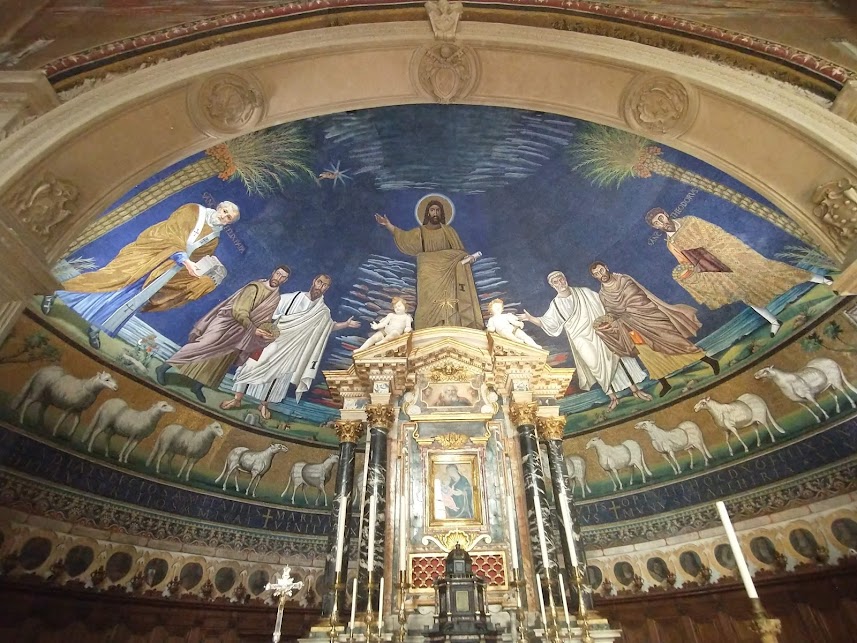
The Basilica dei Santi Cosma and Damiano in Rome was built by uniting parts of the Roman Forum and the Imperial Forums. The biggest attraction is the apse mosaic. The Forma Urbis Romae, a huge marble city map showing what Rome used to look like in the 3rd century, used to adorn one of the outside walls.
A brief history of the basilica of the Santi Cosma and Damiano in Rome
The Chiesa dei Santi Cosma e Damiano is dedicated to two Arab brothers, who were killed in 303. Pope Felice IV, who had been given the church by Emperor Theodoric the Great, decided to dedicate the church to these two twin doctors and early martyrs.
The church itself was constructed by uniting the Library of the Tempio della Pace and one of the aulas of the Tempio del Divo Romolo. The former was part of the Fori Imperiali, the latter of the Foro Romano.
The church was enlarged between 695 and 772.
In 1512, Cardinal Alessandro Farnese gave the church to the Franciscan Order, who ordered a restoration.
In 1632, Pope Urban VIII commissioned another restoration. Because of the swampy, and thus rather unhealthy, terrain, the architects Orazio Torriani and Luigi Arrigucci needed to construct a new floor, seven meters above the original one. This led to the creation of a chiesa inferiore and a chiesa superiore (“a lower and a higher church”).
In those days, the entrance to the church was still in the Via Sacra. Originally this had been the entrance to the Temple of Romulus.
What to see in the basilica of the Saints Cosma and Damiano
Entrance and cloister
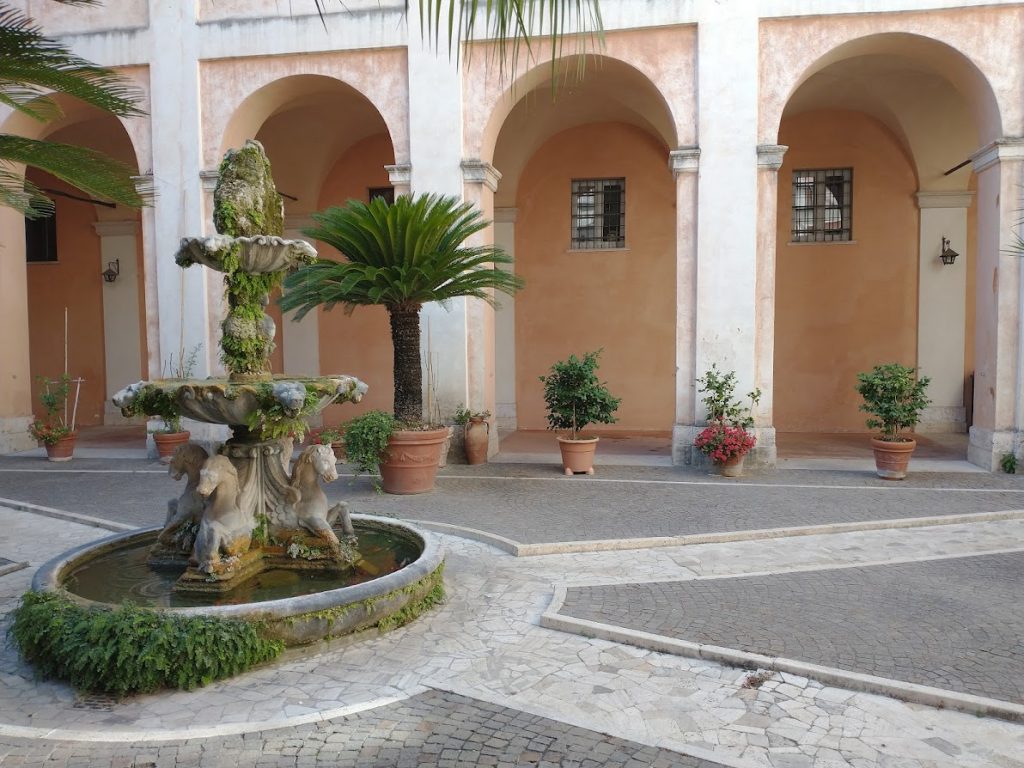

The current entrance is in the Via dei Fori Imperiali. It gives access to an atrium, with an ancient wall of the Biblioteca Pacis. There are two rooms containing well-preserved floors of the Foro della Pace. A hallway leads to a cloister with a central, but badly maintained, fountain. The back wall is decorated with frescoes by Francesco Allegrini, depicting events from the lives of the saints Francis and Luchese. To the right of the entrance of this cloister is a room with an 18th century nativity scene. It was donated to the church in 1939. Some of the figurines were stolen in 1988.
The wall to the left of the entrance is where the 150 marble slabs forming the ancient city map used to be attached. 1186 fragments of the map have been found. The wall still shows the holes where the marble used to be fastened.
Interior
The interior consists of a single nave, ending in a large apse. There are three chapels on the left side and four on the right.
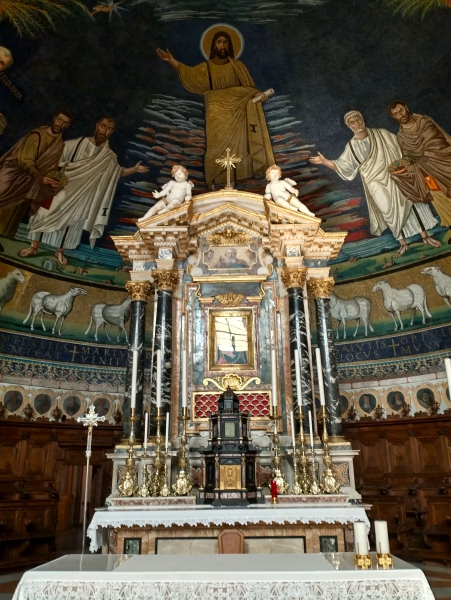
The apse mosaic depicts Christ descending on a carpet of clouds. He is accompanied by the saints Peter, Paul, Theodoric, Cosma and Damiano. The last figure is Pope Felice IV. He is the one holding a model of the church itself. The mosaic dates back to the 6th or 7th century.
The mosaic on the triumphal arch shows the Easter lamb, with seven candles and symbols of the Evangelists.
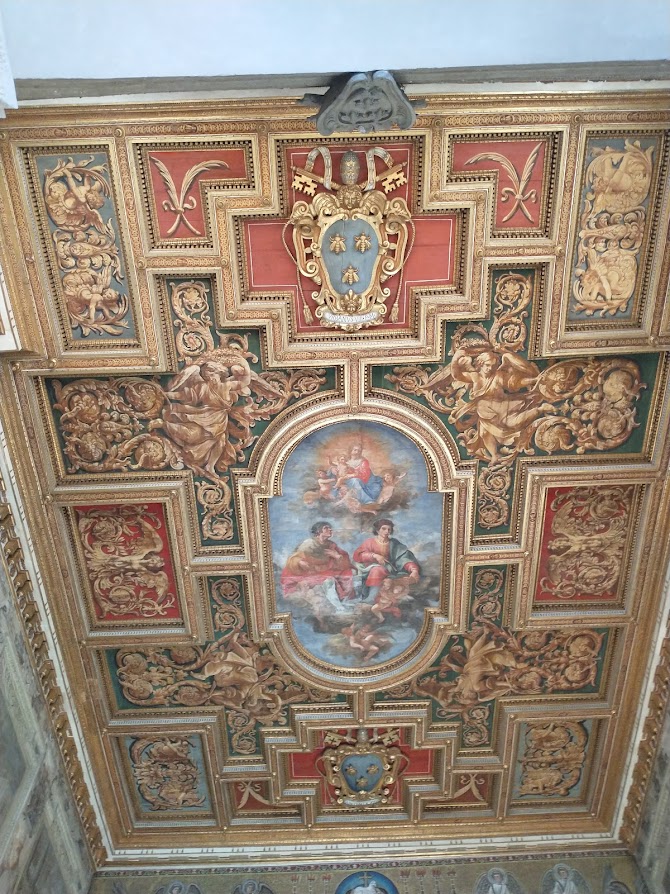
The wooden ceiling is painted with a “Glory of Cosma and Damiano” by Marco Montagna. The three golden bees on a blue background are the coat of arms of the Barberini, the family Pope Urban VIII belonged to. The ceiling dates back to 1632 and was the work of Luigi Arigucci.
The “Madonna and Child” near the main altar of the presbytery was painted in the 13th century.
Chapels on the right
There are four chapels on the right. The first one is the Chapel of the Crucifixion. It is followed by the Baglioni Chapel. The next ones are the Chapel of St. Antony of Padova and of St. Francis of Assisi.
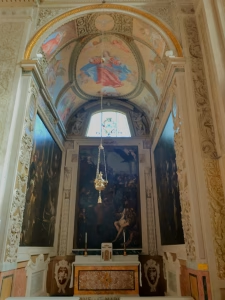
The Cappella Baglioni is dedicated to the family of the painter Giovanni Baglioni (1566-1644), as indicated in one of the inscriptions inside the chapel. The family coats of arms are visible on the sides of the altar. The paintings decorating the chapel are the work of Baglioni himself. They depict “St. John the Evangelist resuscitating a dead man” (above the altar), “Adoration of the Magi” (right), “Presentation” (left), and “the “Virgin in glory” (vault).
Chapels on the left
The first chapel on the left is dedicated to Santa Barbara. The next one is the chapel of Saint Alexander and the last one is the Cappella di Santa Rosa da Lima and Santa Rosalia.
Address and public transportation
The address of the Chiesa dei Santi Cosma e Damiano is Via dei Fori Imperiali, 1 – 00186 Rome. District: Campitelli. Bus: 51, 85, 87, 186, 810. Metro: Colosseo (line B).
Useful information
Opening times: From 09.00 to 13.00 and from 15.00 to 19.00. Ticet price: Free of charge. Telephone: +39 +39 06 6990808.
Leave a Reply