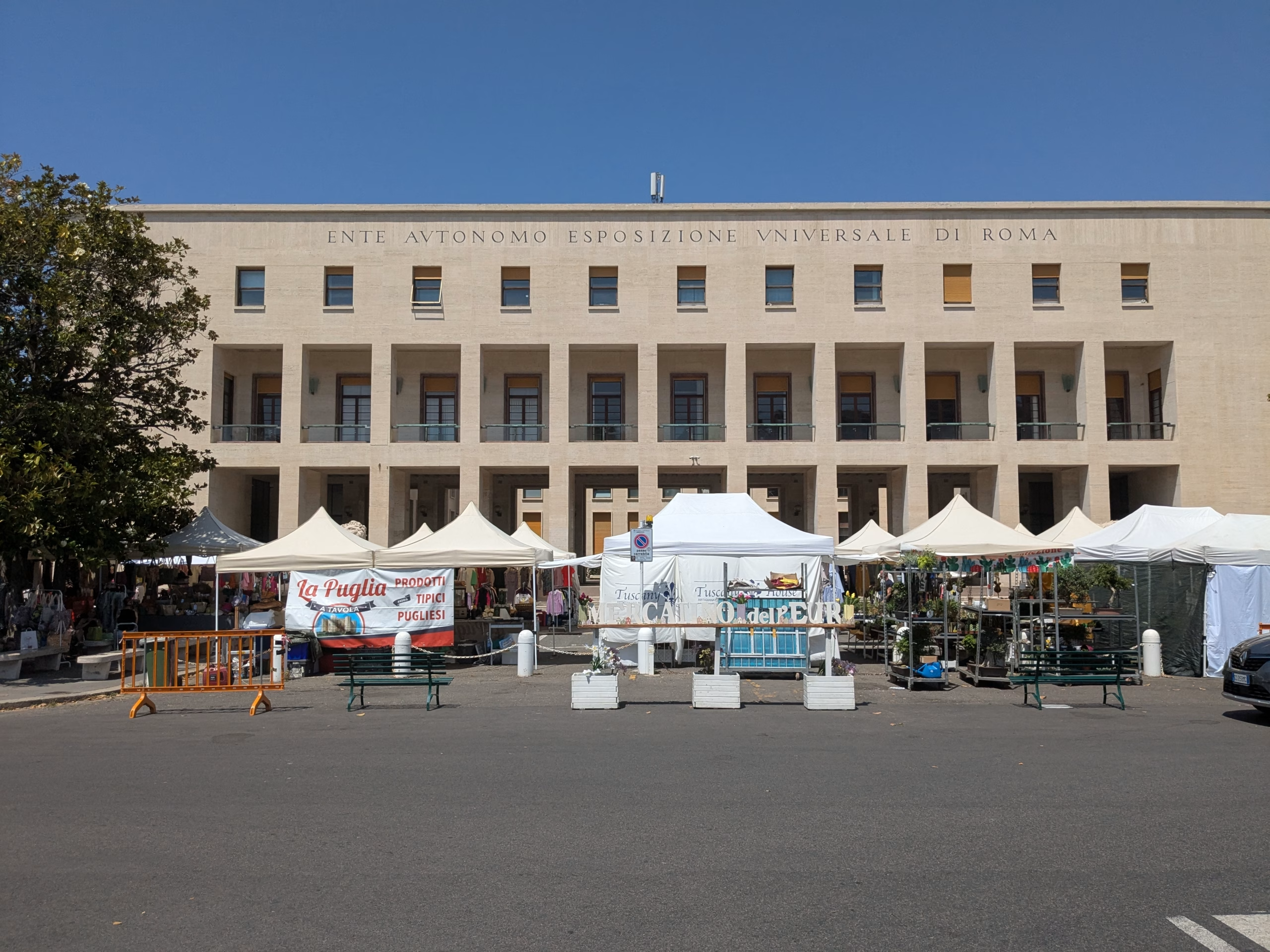
The Palazzo degli Uffici is a building in the EUR district in Rome. Built for the 1942 Esposizione Universale di Roma, which in the end never happened, half of the complex currently hosts the offices of the department overseeing the cultural heritage of the district. The other half, under the name Salone delle Fontane, is now a space dedicated to cultural events.
A brief history of the Palazzo degli Uffici in Rome
The palazzo, which consists of two perpendicular constructions, was designed by Gaetano Minnucci. The project was supervised by Marcello Piacentini and the architect in charge of the actual constructions was called Pietro Ferri. Piacentini was the main architect in the fascist Italy of the 1930s.
Of all the newly constructed palaces in the EUR district, the Palazzo degli Uffici was the first one to be completed, in 1939. It consists of two buildings. The facades face the Largo Virgilio Testa and the Via Ciro il Grande, respectively.
The first one of these has a square floor plan and a central courtyard. The top part of the facade contains the inscription “ENTE AUTONOMO ESPOSIZIONE UNIVERSALE DI ROMA”.
The building included an air raid shelter for around 300 people. Until recently, these rooms were used for exhibitions, but they are now closed for reasons of safety.
Salone delle Fontane
The second building is rectangular and features an exhibition space covering an area of 2.000 m². Its facade is preceded by the fountains to which the building owes its current name. The fountain consists of 18 tubs, with black and white decorations by Gino Severini, Giulio Rosso and Giovanni Guerrini.
The rather long inscription on the facade is a quote from a speech by Mussolini in 1925 and can be translated as: “The Third Rome will expand over other hills along the banks of the sacred river to the beaches of the Tyrrhenian Sea”. The first two Romes were ancient, and Papal Rome.
The bronze statue of the boy raising his right arm was originally called “Genio del Fascismo”, and was the work of Italo Griselli. After World War II, it was supplied with boxing gloves and rebaptized “Genio dello Sport”.
The relief of the long marble frieze decorating the facade was the work of Publio Morbiducci. It shows the history of Rome by means of it building works. Morbiducci (1889-1963) also made some of the statues of the adjacent Palazzo della Civilta Italiana, the Fountain in the Piazza del Viminale and the Statue of the Bersagliere in front of the Porta Pia. In 1923, he designed the new 2 Lira coin.
Points of interest inside the building include a scale model showing the district durint the 1960 summer Olympics, preparatory designs for the Basilica dei Santi Pietro e Paolo, two sculpture groups by Dino Basaldella and a fresco depicting the “Foundation of Rome’, by Giorgio Quaroni.